
1. Introducció
The Dwyer Series 475 Mark III Handheld Digital Manometer, model 475-3-FM-BK, is a versatile instrument designed for measuring positive, negative, or differential pressures of air and compatible combustible gases. This device is ideal for field calibration, monitoring, or troubleshooting HVAC systems, clean rooms, and various low-pressure pneumatic systems. It offers dual range capabilities, providing measurements in both inches of water column (WC) and kilopascals (KPA).
2. Informació de seguretat
- Llegiu aquest manual detingudament abans de fer funcionar el dispositiu.
- Ensure the manometer is used only with air and compatible combustible gases as specified.
- Do not exceed the specified pressure ranges of the instrument.
- The Series 475-FM is approved as intrinsically safe for hazardous locations: Class 1, Div. 1, Group A, B, C, D, T4. Always adhere to safety protocols for such environments.
- Replace batteries only in non-hazardous areas.
- Keep the device away from extreme temperatures, moisture, and strong vibrations.
3. Producte acabatview
The Dwyer 475-3-FM-BK manometer features a rugged extruded aluminum case, ensuring durability. It includes a large, easy-to-read digital display and intuitive push-button controls for operation.
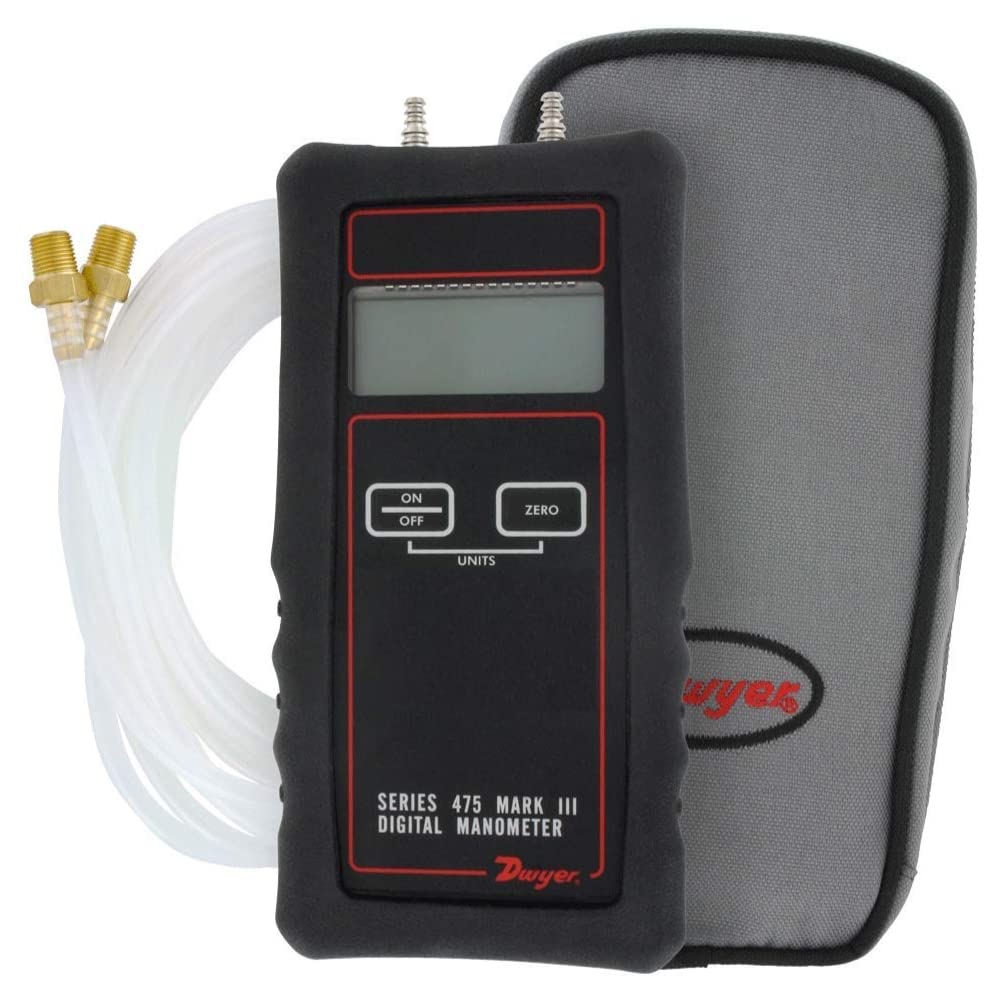
Image 1: Dwyer 475-3-FM-BK Handheld Digital Manometer. The image displays the black manometer unit encased in a protective boot, with a digital display and three control buttons labeled 'ON OFF', 'ZERO', and 'UNITS'. To the left, clear vinyl tubing and brass hose barb adapters are visible. A gray carrying case is partially visible on the right.
Components clau:
- Pantalla digital: Shows pressure readings and selected units.
- Botó ON/OFF: Encén i apaga el dispositiu.
- Botó ZERO: Used to zero the display before taking measurements.
- Botó UNITATS: Cycles through available pressure units.
- Pressure Ports: Located at the top for connecting tubing.
- Bota de protecció: Provides additional protection against impact.
- Hose Barb Adapters & Tubing: For connecting to pressure sources.
- Estoig de transport: For safe transport and storage.
4. Configuració
4.1 Instal·lació de la bateria
- Ensure the manometer is powered off.
- Localitzeu la tapa del compartiment de la bateria a la part posterior de la unitat.
- Remove the cover and insert a standard 9-volt battery, observing correct polarity.
- Replace the battery compartment cover securely. A fresh 9V battery provides up to 100 hours of operation.
4.2 Connexió de tubs
- Attach the clear vinyl tubing to the hose barb adapters.
- Connect the adapters to the pressure ports on top of the manometer. For differential pressure, connect one tube to each port. For positive or negative pressure, connect to one port and leave the other open to atmosphere.
5. Instruccions de funcionament
5.1 Engegada/apagada
- To power on the manometer, press the ON/OFF botó.
- To power off the manometer, press the ON/OFF botó de nou.
5.2 Zeroing the Device
- Before taking any measurements, ensure both pressure ports are open to the atmosphere (not connected to any pressure source).
- Premeu el botó ZERO button. The display should read 0.00. This calibrates the device for accurate readings.
5.3 Selecting Units
- Premeu el botó UNITATS button to cycle through the available pressure units (e.g., inches of water column, kilopascals). Select the desired unit for your measurement.
5.4 Prendre mesures
- After zeroing and selecting units, connect the tubing from the pressure source to the appropriate pressure port(s).
- The digital display will show the pressure reading.
- For air velocity measurements, the Series 475 Mark III can be used in conjunction with a Dwyer Pitot tube. Air velocity calculations will need to be performed separately based on the differential pressure reading.
6. Manteniment
6.1 Substitució de la bateria
When the battery indicator appears on the display, replace the 9V battery as described in the Setup section (4.1 Battery Installation).
6.2 Neteja
Clean the exterior of the manometer with a soft, damp cloth. Do not use abrasive cleaners or solvents. Ensure no moisture enters the pressure ports or internal components.
6.3 Emmagatzematge
When not in use, store the manometer in its protective carrying case in a clean, dry environment, away from extreme temperatures.
7. Solució De Problemes
- Sense pantalla: Comproveu la instal·lació de la bateria i assegureu-vos que tingui prou càrrega. Substituïu-la si cal.
- Lectures inexactes: Ensure the device was properly zeroed before measurement. Check for any leaks in the tubing connections. Verify the correct pressure unit is selected.
- Lectures erràtiques: Ensure the measurement environment is stable and free from sudden pressure fluctuations. Check for loose connections or damaged tubing.
- El dispositiu no respon: Try removing and reinserting the battery. If the issue persists, contact customer support.
8. Especificacions
| Especificació | Valor |
|---|---|
| Dimensions del producte | 6 x 3.5 x 0.75 polzades |
| Pes de l'article | 1.5 lliures |
| Fabricant | Dwyer Instruments, Inc. |
| Material | Alumini |
| Font d'alimentació | 9V Battery (up to 100 hours operation) |
| Intervals de pressió | 0-199.9" WC & 0-49.7 KPA (Dual Range) |
| Servei | Air and Compatible Combustible Gases |
| Hazardous Location Approval | Class 1, Div. 1, Group A, B, C, D, T4 (for 475-FM model) |
9. Garantia i Suport
Warranty information for the Dwyer 475-3-FM-BK Handheld Digital Manometer is typically provided with the product at the time of purchase or can be obtained directly from the manufacturer. For technical support, service, or inquiries regarding warranty claims, please contact Dwyer Instruments, Inc. through their official weblloc o canals d'atenció al client.