Taidacent 5.8G Microwave Radar Sensor Module MG5820 (DC7-12V) User Manual
Brand: Taidacent | Model: MG5820
1. Producte acabatview
The Taidacent MG5820 is a 5.8G microwave radar sensor module designed for human movement detection. It utilizes the Doppler effect to detect moving objects in real-time, converting microwave induction signals into high/low level or PWM signals. This module offers strong anti-interference capabilities, high stability, sensitivity, and environmental adaptability, making it an effective alternative to infrared (PIR) and voice control sensors. It features penetrability and a wide sensing angle without dead zones.
Adjustable delay time after induction trigger (default 3 seconds)
Supports light intensity sensing (photoresistor not attached by default)
Compact size: 20mm × 20mm × 2.5mm
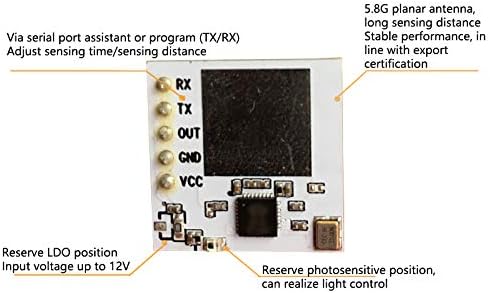
Figure 1: Taidacent MG5820 module with key features labeled, including the 5.8G planar antenna, LDO position, photosensitive position, and serial port for adjustments.
2. Configuració i connexions
This section details the pin assignments and power supply requirements for the MG5820 module.
2.1 Descripció del pin
VCC: Power supply positive. For the DC7-12V version (with LDO attached), VCC is 7-12V. The module's default power consumption is 35mA, with a recommended power drive capability of >50mA.
GND: Terra d'alimentació.
SORTIDA: Inductive output. Default output is high and low level. Can be modified to PWM output as needed.
TX: Serial port transmit. Can be used for software upgrades or parameter adjustments (pins not welded by default).
RX: Serial port receive. Can be used for software upgrades or parameter adjustments (pins not welded by default).
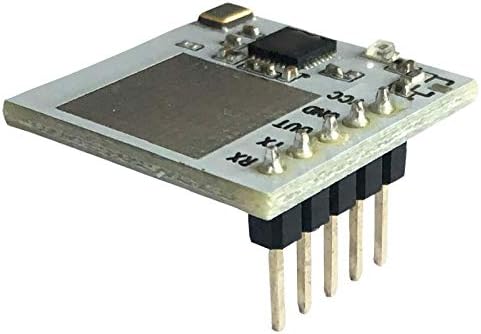
Figura 2: superior view of the MG5820 module illustrating the VCC, GND, OUT, TX, and RX pins.
2.2 Font d'alimentació
Assegureu-vos que la font d'alimentació voltage is within the specified range of 7-12V for the DC7-12V version. The power source should be capable of supplying at least 50mA to ensure stable operation.
3. Operating Principles and Adjustments
The MG5820 module operates on the Doppler effect, detecting frequency shifts in reflected microwave signals caused by moving objects. This allows for reliable motion detection.
3.1 Senyal de sortida
The OUT pin provides an inductive output. By default, it outputs a high (5V) or low (0V) level signal. This can be configured to output a Pulse Width Modulation (PWM) signal if required for specific applications.
3.2 Ajust de paràmetres
Several parameters of the module can be adjusted to suit different application needs:
Distància de detecció: The detection range can be adjusted. The factory default is 8 meters, with a maximum range exceeding 15 meters.
Temps de retard: The duration for which the output signal remains active after detection can be adjusted. The default delay time is 30 seconds.
Photosensitive Threshold: If a photoresistor is attached, the module can incorporate light intensity sensing. The photosensitive threshold (default 10 Lux) can be adjusted to control operation based on ambient light.
Adjustments to sensing time and distance can be made via the TX/RX serial port using a serial port assistant or dedicated program. The serial port pins are not welded by default.
4. Manteniment
The Taidacent MG5820 module is designed for robust operation. To ensure longevity and optimal performance:
Operate the module within the specified working temperature range of -30°C to 85°C.
Avoid exposing the module to excessive moisture, dust, or corrosive environments.
Ensure proper ventilation if enclosed to prevent overheating.
Manipuleu el mòdul amb cura per evitar danys físics als components o als pins.
5. Solució De Problemes
If you encounter issues with the MG5820 module, consider the following:
Sense detecció:
Comproveu que la font d'alimentació voltage is correct (7-12V for this version) and stable.
Check all pin connections (VCC, GND, OUT) for proper contact.
Ensure there are no obstructions directly in front of the sensor that could block microwave signals.
Confirm that the sensing distance parameter is set appropriately for your environment.
False Detections:
Reduce the sensing distance if the module is detecting movement beyond the desired area.
Ensure the module is not placed near sources of strong electromagnetic interference.
Consider the environment; microwave sensors can detect movement through thin walls or non-metallic objects.
Sortida incorrecta:
Verify the OUT pin connection to your control circuit.
If using PWM output, ensure the module is configured correctly via the serial port.
For persistent issues, refer to the detailed specifications or contact technical support.
6. Especificacions
Detailed technical specifications for the Taidacent MG5820 module:
Paràmetre
Valor
Freqüència de transmissió
5725~5875MHz (Typ 5800MHz)
Potència de transmissió
0.5 ~ 1 mW
Entrada Voltage (DC7-12V version)
7~12V (with LDO attached)
Sortida d'alt nivell
5V
Sortida de baix nivell
0V
Corrent de treball
Typ 38mA (Max 50mA)
Hanging Height (Typical)
3M (Adjustable, Max 6M)
Sensing Distance (Typical)
5M (Adjustable, Max 12M)
Delay Time (Default)
30S (Adjustable)
Photosensitive Threshold (Default)
10Lux (Adjustable)
Temperatura de treball
-30~85°C
Dimensions (W×L×T)
20 mm × 20 mm × 2.5 mm
Número de model
ZC-MG5820sensor-0202
UPC
792323450340
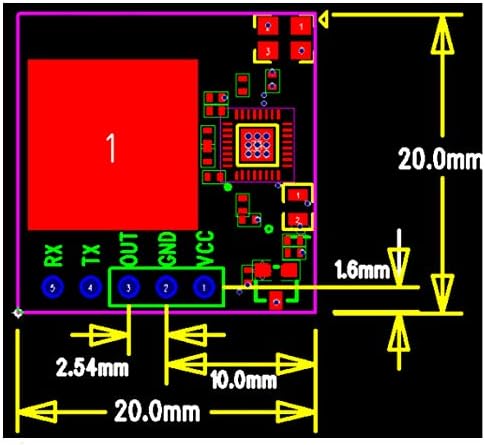
Figure 3: Dimensional drawing of the MG5820 module, showing its compact size and pin layout.
7. Garantia i Suport
Warranty information for the Taidacent MG5820 module is typically provided by the seller or manufacturer at the time of purchase. Please refer to your purchase documentation or contact the seller directly for specific warranty terms and conditions.
For technical support, inquiries, or further assistance with the MG5820 module, please contact Taidacent directly or the authorized reseller from whom you purchased the product. You may also visit the official Taidacent Store on Amazon per obtenir recursos addicionals.
Ask a question about this manual
Ask about setup, troubleshooting, compatibility, parts, safety, or missing instructions. Manuals+ will review the question and use this page’s manual context to help answer it.