1. Introducció
The MOOG Theremini is a modern re-imagination of the classic theremin, an electronic musical instrument played without physical contact. It combines the unique gestural control of a theremin with a powerful sound engine derived from the award-winning Animoog synthesizer. Designed for musicians of all skill levels, the Theremini features an assistive Pitch Correction system, 22 selectable scales, 12 root notes, 32 presets, a built-in tuner, speaker, and various connectivity options for versatile musical expression and experimentation.
This manual provides essential information for setting up, operating, maintaining, and troubleshooting your Theremini to ensure optimal performance and enjoyment.
2. Què hi ha a la caixa
- Theremini Unit
- Adaptador de corrent altern
- Targeta de garantia
- Manual d'usuari (aquest document)
- Guia d'inici ràpid
3. Configuració
3.1 Col·locació inicial
Place your Theremini on a stable, flat surface. For optimal performance, ensure it is away from large metal objects, other electronic devices, and strong electromagnetic fields, which can interfere with antenna sensitivity.
3.2 Connexió d'alimentació
Connect the provided AC Power Adaptor to the DC IN port on the rear of the Theremini and plug it into a standard electrical outlet.
3.3 Extensió d'antena
Fully extend both the pitch and volume antennas. The pitch antenna is the vertical rod, and the volume antenna is the horizontal loop.

Image: MOOG Theremini with antennas extended.
3.4 Sortida d'àudio
For private practice, connect headphones to the 1/8" TRS Headphone Output. For external amplification or recording, use the Left and Right 1/4" TS Outputs to connect to an amplifier, mesclador o interfície d'àudio.
3.5 Calibració de l'antena
Accurate antenna calibration is crucial for proper Theremini operation. This process establishes the null point (where no sound is produced) and the playable range.
- Place the Theremini in its intended playing position.
- Ensure the volume knob is turned up and the pitch correction is set to a comfortable level (e.g., medium).
- Keep your hands away from both antennas. The Theremini should be silent.
- Slowly move your hand towards the pitch antenna. You should hear a tone. Adjust the pitch knob until the tone is at a desired low pitch when your hand is approximately 30cm away, and silent when your hand is at your side.
- Repeat for the volume antenna, adjusting the volume knob so that the volume increases as your hand moves closer to the loop.
For a visual guide on antenna calibration, please refer to the official tutorial video below:
Video: Tutorial on Antenna Calibration for Theremini.
4. Operating the Theremini
4.1 Tècniques de joc
The Theremini is played by moving your hands in the electromagnetic fields around its two antennas. The vertical antenna controls pitch, and the horizontal loop controls volume. Moving your hand closer to the pitch antenna raises the pitch, while moving your hand closer to the volume loop decreases the volume.

Image: Basic hand positions for playing the Theremini.
4.2 Pitch Correction and Scales
The Theremini features an adjustable Pitch Correction system. This system can be set to various levels, from full correction (quantizing notes to a selected scale) to no correction (allowing for continuous pitch slides, like a traditional theremin). Use the 'Scale' and 'Root' controls to select from 22 available scales and 12 root notes.

Image: Theremini LCD screen displaying scale and root settings.
4.3 Presets and Sound Engine
The internal sound engine, based on MOOG's Animoog synthesizer, offers 32 distinct presets. Each preset provides a unique tonality or timbre. Use the 'Presets' knob to cycle through these sounds. An onboard stereo effects section (delay, reverb) can be applied to add depth and spaciousness.

Image: Theremini with Animoog software interface.
4.4 Built-in Tuner and Speaker
A built-in tuner provides real-time visual feedback on the LCD screen, showing the note being played and its proximity to perfect pitch. The integrated speaker allows for immediate sound output, while the headphone jack is ideal for private practice.
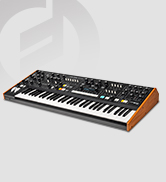
Image: Theremini built-in speaker.
4.5 Connectivitat
- Sortida del CV: A 1/4" TS CV Output with selectable range allows for control of external analog synthesizers.
- MIDI per USB: The Mini-B USB 2.0 port enables MIDI connectivity for integration with digital audio workstations (DAWs) and software editors.
Learn more about selecting modes and playing your Theremini with the tutorial video below:
Video: Tutorial on Mode Selection for Theremini.
5. Manteniment
To ensure the longevity and optimal performance of your MOOG Theremini, follow these maintenance guidelines:
- Neteja: Use a soft, dry, lint-free cloth to clean the exterior surfaces. Avoid abrasive cleaners, solvents, or waxes. Do not spray liquids directly onto the unit.
- Emmagatzematge: Store the Theremini in a cool, dry place away from direct sunlight, extreme temperatures, and high humidity. When not in use, retract the antennas to prevent accidental damage.
- Manipulació: Manipuleu la unitat amb cura. Eviteu deixar-la caure ni sotmetre-la a impactes forts.
6. Solució De Problemes
If you encounter issues with your Theremini, try the following troubleshooting steps:
- Sense so/So intermitent:
- Check power connection and ensure the unit is turned on.
- Verify volume levels on the Theremini and any connected audio equipment.
- Recalibrate the antennas (refer to Section 3.5). Environmental factors can affect calibration.
- Ensure no large metal objects or other electronic devices are too close to the antennas.
- Incorrect Pitch/Tuning Issues:
- Perform antenna calibration (Section 3.5).
- Adjust the Pitch Correction level to suit your playing style. Higher correction levels can help maintain pitch accuracy.
- Check the selected scale and root note to ensure they match your desired musical context.
- Connectivity Problems (MIDI/CV):
- Assegureu-vos que tots els cables estiguin ben connectats.
- For USB MIDI, verify that your computer or DAW recognizes the Theremini. Install any necessary drivers if prompted.
- For CV output, ensure the receiving device is correctly configured to accept CV signals and the range is appropriately set on the Theremini.
7. Especificacions
| Característica | Detall |
|---|---|
| Mida | 6.5 "P x 22.75" W x 15" H |
| Pes de l'article | 2.55 lliures (1.16 quilograms) |
| Font d'alimentació | Elèctric amb cable |
| Tecnologia de connectivitat | 1/4" TS CV Output, 1/8" TRS Headphone Output, Left and Right 1/4" TS Output, Mini-B USB 2.0 Port |
| Interfície del maquinari | USB |
| Característica especial | Built-In Speaker, Headphone Jack, Pitch Correction, Standalone, Tuner |
| Motor de so | Animoog Synthesizer Sound Engine with 32 Presets |
| Correcció de to | Adjustable, with 22 Scales and 12 Root Notes |
| Compatibilitat de sistemes operatius | Windows, iOS, macOS (for software editor) |
8. Garantia
The MOOG Theremini comes with a manufacturer's warranty. Please refer to the Warranty Card included in your product packaging for specific terms, conditions, and duration of coverage. Retain your proof of purchase for warranty claims.
9. Suport
For further assistance, technical support, or to access additional resources such as software updates and tutorials, please visit the official MOOG website or contact their customer service department. Online resources often include FAQs, user forums, and detailed guides to help you get the most out of your Theremini.


