Coberta manual

Image: Front cover of the Singer 2282 Sewing Machine Instruction Manual.
Instruccions importants de seguretat
When using an electric appliance, basic safety precautions should always be followed, including the following:
DANGER - To reduce the risk of electric shock:
- Always unplug the machine immediately after using and before cleaning.
- Always unplug before replacing a light bulb. Replace bulb with same type rated 10 watts (110-120V area) or 15 watts (220-240V area).
WARNING - To reduce the risk of burns, fire, electric shock, or injury to persons:
- No permetre que s'utilitzi com a joguina. Cal prestar molta atenció quan aquest aparell és utilitzat per o a prop dels nens.
- Utilitzeu aquest aparell només per a l'ús previst tal com es descriu en aquest manual. Utilitzeu només els accessoris recomanats pel fabricant tal com s'inclouen en aquest manual.
- No feu servir mai aquest aparell si té un cable o un endoll danyats, si no funciona correctament, si s'ha caigut o s'ha fet malbé, o si ha caigut a l'aigua. Envieu l'aparell al distribuïdor o centre de servei autoritzat més proper per a l'examen, la reparació, l'ajust elèctric o mecànic.
- Never operate the appliance with any air openings blocked. Keep ventilation openings of the sewing machine and foot controller free from the accumulation of lint, dust, and loose cloth.
- Mantingueu els dits allunyats de totes les parts en moviment. Es requereix una cura especial al voltant de l’agulla de la màquina de cosir.
- Utilitzeu sempre la placa d'agulla adequada. La placa incorrecta pot fer que l'agulla es trenqui.
- No estireu ni empenyeu la tela mentre esteu cosint. Pot desviar l'agulla fent que es trenqui.
- Always unplug the sewing machine from the electrical outlet when removing covers, lubricating, or when making any other servicing adjustments mentioned in the instruction manual.
- No deixeu caure ni introduïu cap objecte a cap obertura.
- No utilitzar a l'aire lliure.
- No opereu on s'utilitzen productes en aerosol (esprai) o on s'administra oxigen.
- To disconnect, turn all controls to the off ("O") position, then remove plug from outlet.
- No desconnecteu estirant del cable. Per desconnectar, agafa l'endoll, no el cable.
- El nivell de pressió acústica en condicions normals de funcionament és de 75 dB(A).
- Never turn off the machine or unplug when the machine is not running properly.
- No col·loqueu mai res al pedal.
- If the supply cord that is fixed with foot controller is damaged, it must be replaced by the manufacturer or its service agent or a similarly qualified person in order to avoid a hazard.
- Aquest aparell no està pensat per ser utilitzat per persones (inclosos nens) amb capacitats físiques, sensorials o mentals reduïdes, o amb manca d'experiència i coneixements, tret que hagin rebut la supervisió o instruccions sobre l'ús de l'aparell per una persona responsable de la seva seguretat.
- Els nens han de ser supervisats per assegurar-se que no juguin amb l'aparell.
DESA AQUESTES INSTRUCCIONS
Aquesta màquina de cosir està pensada només per a ús domèstic.
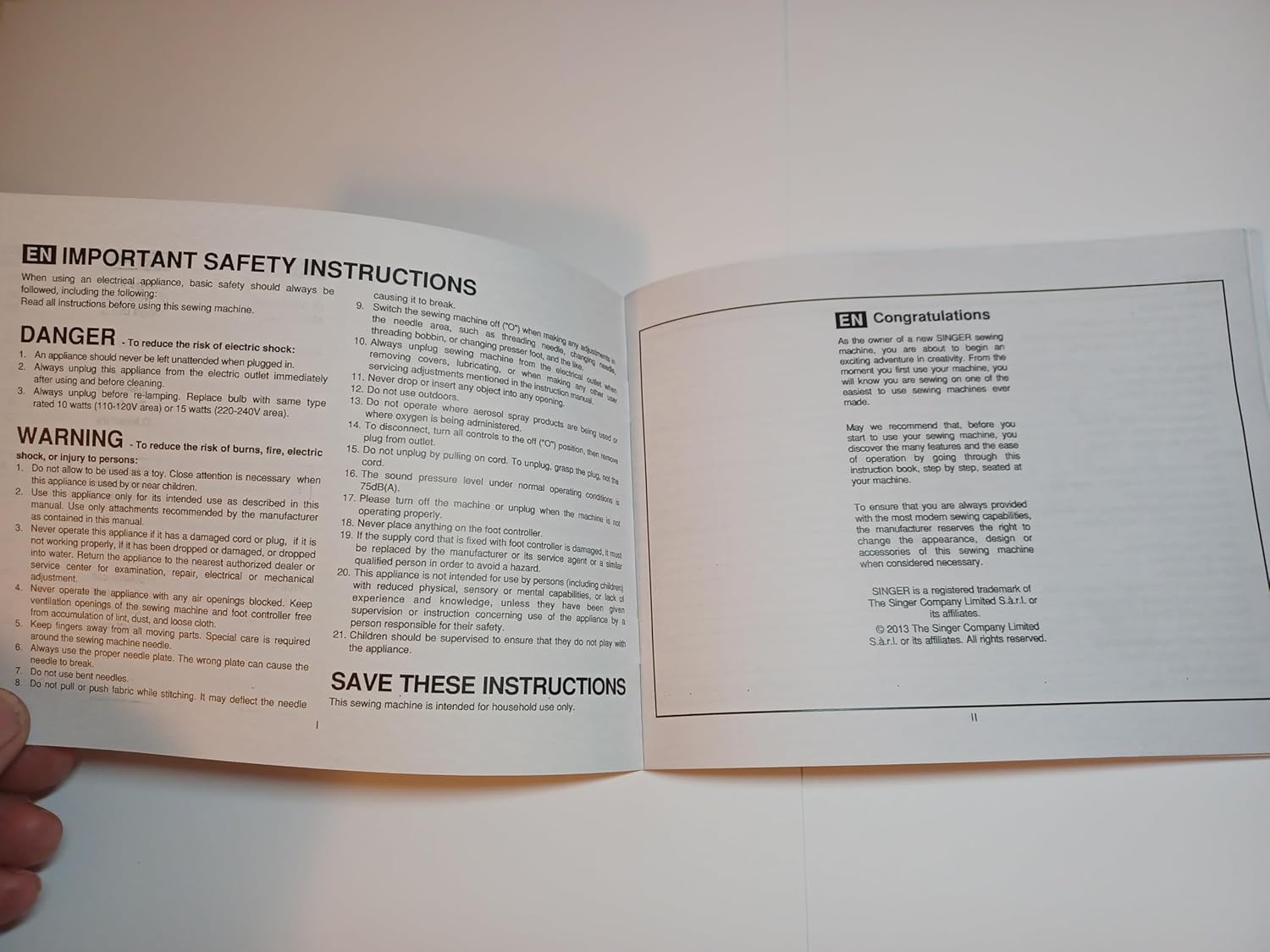
Image: Important Safety Instructions and Congratulations page from the manual.
Primers passos
Felicitats!
As the owner of a new SINGER sewing machine, you are about to begin an exciting adventure in creative sewing. The first step to learn your machine, you will know you are sewing by doing. So, prepare to sew! Sewing machines are made for sewing.
May we recommend that, before you use your new sewing machine, you discover the many features and the ease of operation by reading through this instruction book, step by step, seated at your machine.
To ensure that you are always provided with the finest sewing capabilities, the manufacturer reserves the right to change the appearance, design, or accessories of this sewing machine when considered necessary.
SINGER is a registered trademark of The Singer Company Limited S.à.r.l. or its affiliates. © 2013 The Singer Company Limited S.à.r.l. or its affiliates. All rights reserved.
Configuració
Before beginning any sewing project, ensure your Singer 2282 machine is properly set up. This involves connecting the power, installing the needle, and preparing the bobbin.
Connexió d'alimentació
- Assegureu-vos que la màquina estigui apagada.
- Insert the power cord into the machine's power input.
- Connecteu l'altre extrem del cable d'alimentació a una presa de corrent adequada.
- Connecteu el pedal al port designat de la màquina.
Instal·lació d'agulles
- Puja l'agulla a la posició més alta amb el volant.
- Afluixeu l'agulla clamp cargol.
- Insert the new needle with the flat side facing the back of the machine.
- Push the needle up as far as it will go, then tighten the needle clamp cargol de manera segura.
Bobinat de bobina
- Col·loqueu una bobina de fil al portacarret.
- Guieu el fil a través del guiafils superior i al voltant del disc tensor de la bobina.
- Col·loqueu una bobina buida a l'eix de la bobinadora.
- Enrotlla el fil manualment unes quantes vegades al voltant de la bobina.
- Empenyeu l'eix de la bobina de bobina cap a la dreta.
- Premeu el pedal per començar a bobinar. Atureu-vos quan la bobina estigui plena.
- Cut the thread and push the bobbin winder spindle to the left.
Operating Your Sewing Machine
Enfilant la màquina
Proper threading is crucial for correct stitch formation. Follow these steps carefully for both upper and lower threading.
Enfilar el fil superior
- Start by raising the needle to its highest point (1), and continue turning the handwheel counter-clockwise until the needle just begins to descend. Raise the presser foot to release the tension discs.
- Nota: Per seguretat, es recomana que apagueu l'alimentació abans d'enfilar.
- Col·loqueu el carret de fil al passador del carret.
- Draw thread from the spool through the upper thread guide (3) and proceed through pre-tension spring as illustrated (4).
- Thread tension module by leading thread down right channel and up left channel (5). During this process it is helpful to hold the thread between the spool and thread guide.
- At the top of this movement pass thread from right to left, through the slotted eye of the take-up lever and then downwards again.
- Ara passeu fil per darrere de l'agulla de filferro prima clamp guide (7) and then down to the needle which should be threaded from the front to back.
- Pull about 6-8 inches of thread to the rear beyond the needle eye. Trim thread to length with built-in thread cutter (8).
Thread Tension Adjustment
Correct thread tension is essential for balanced stitches. Adjust the tension dial as needed.
- Upper Thread Tension: To reduce the tension, turn the dial to the next number up. To increase the tension, turn the dial to the next number down. Try to achieve balanced tension for straight stitch sewing. Turn dial to "4".
- Lower Thread Tension: To test the bobbin thread tension, remove the bobbin case and bobbin. Hold the thread coming from the bobbin. If the tension is correct, the thread will unwind slowly. If it unwinds too fast, it will drop too much. If it unwinds too slowly, it will not drop.
Tingueu en compte:
- Proper setting of tension is important for good sewing.
- The correct tension for example, top, bottom, and all stitch functions, thread or fabric.
- The tension is correct when both upper and bottom is usually only desirable for straight stitch construction.
- 90% of all sewing will be between "3" and "5".
- For zig zag and decorative sewing stitch functions, thread tension will be less than for straight stitch sewing.
- For decorative sewing you will always obtain a nice stitch and foot fabric puckering when the upper thread appears on the bottom side of your fabric.

Image: Instructions for Thread Tension and Threading the Upper Thread.
Stitch Selection and Adjustment
The Singer 2282 offers various stitch patterns and adjustments for different sewing needs.
Com triar el vostre patró
To select a stitch pattern, simply turn the Pattern Selector Dial. The Pattern Selector Dial may be turned in either direction.
- For straight stitch: select pattern "1" with the pattern selector dial. Adjust the stitch length with the stitch length dial.
- For zigzag stitch: select pattern "2" with the pattern selector dial. Adjust the stitch length and stitch width according to the fabric being used.
- To obtain the other patterns: turn the stitch length dial to "0" or "Sz", select the pattern desired with pattern selector dial, and adjust the stitch width with the stitch width dial.
Stitch Width & Stitch Length Dial
- Function of stitch width dial: The maximum zigzag stitch width for zigzag stitching is 5mm. However, the width can be reduced by turning the dial. The width increases as the dial is turned from "0" - "5" (1). The Stitch Width Dial is also the control for the straight stitch while needle position. "0" position is for left, "5" for full right and between "2" and "3" is for center needle position.
- Function of stitch length dial while zig-zag stitching (2/A): Set the Pattern Selector Dial to zig-zag. The density of zig-zag stitches increase as the setting of stitch length dial approaches "0". Next zig-zag stitches are usually achieved at "2.5" or below. Dense zig-zag stitches are called satin stitches.
- Function of stitch length dial for when straight stitching (2/B): For straight stitch sewing, turn the Pattern Selector Dial to the straight stitch setting. Turn the Stitch Length Dial, and the length of the individual stitches will decrease as the dial is approached "0". The length of the individual stitches will increase as the dial approaches "4". Generally speaking, use a longer stitch when sewing heavy-weight fabrics or when using a thicker needle or thread. Use a shorter stitch length when sewing lighter weight fabrics or when using a finer needle or thread.

Image: Instructions for Pattern Selection and Stitch Width/Length Dial.
Operacions especials
Making a Buttonhole (1-Step Buttonhole)
The 1-step buttonhole feature provides reliable and consistent buttonholes. It is strongly suggested to practice on a scrap piece of fabric before sewing buttonholes on your garment.
- Mark the position of the buttonhole on the fabric.
- Attach the buttonhole foot and set the Pattern Selector Dial to the buttonhole symbol.
- Set stitch length dial to "0" and the stitch width at "7". The stitch length may need to be adjusted according to the fabric being used.
- Lower the presser foot aligning the marks on foot with the marks on the fabric.
- Align the mark on the fabric (A) with the mark on the foot (B).
- Lower the buttonhole lever (C) completely.
- Baixeu la palanca dels botoners i empenyeu-la suaument cap enrere (C).
- Start sewing. The machine will automatically sew the buttonhole.
- Buttonhole stitching is done in the order (D). The machine will stop automatically when the buttonhole has completed.
Making Buttonholes on Stretch Fabric:
When sewing buttonholes on stretch fabric, hook heavy thread or cord onto the buttonhole foot. This will prevent the buttonhole edges and overcoat the cord.
- Place the heavy thread or cord on the fabric with the tailor's chalk, adjust the buttonhole foot, and set the pattern selector dial to the buttonhole symbol.
- Hook the heavy thread onto the back end of the buttonhole foot.
- Pull the heavy thread to the front of the buttonhole foot, insert them into the grooves and temporarily tie them down.
- Baixeu el peu de premsa i comenceu a cosir.
- When the buttonhole is completed, cut the heavy thread.
- When sewing is completed, gently pull the heavy thread to the front and back, then trim off the excess.
Cosir botons
To sew a two-securing stitches, set the machine for straight stitch, with a stitch width set "0".
- Mark the needle out of the fabric. Set the machine for zig zag stitch, then set the stitch number "3" - "5". Turn the handwheel so that the needle goes cleanly into the left and right holes of the button. Adjust the stitch width for needed, and the proper distance between the holes of the button. Slowly sew on the button with about 10 stitches.
- Raise the needle out of the fabric. Set the machine for straight stitch again with the width set "0". Sew a few securing stitches to finish.
- If a shank is required, place a darning needle on top of the fabric and sew. For buttons with 4 holes, sew through the front two holes first, push the work forward and then sew through the back two holes.

Image: Instructions for 1-Step Buttonhole and Sewing on Buttons.
Manteniment
Regular maintenance ensures the longevity and optimal performance of your Singer 2282 sewing machine.
Neteja de la seva màquina
- Desconnecteu sempre la màquina abans de netejar-la.
- Traieu la placa de l'agulla i la caixa de la bobina.
- Use a small brush to remove lint and dust from the feed dogs and bobbin area.
- Wipe the exterior of the machine with a soft, dry cloth. Do not use harsh chemicals.
Lubricació
Your Singer 2282 sewing machine is designed to require minimal lubrication. Refer to the original manual for specific oiling points if necessary. Over-oiling can attract lint and cause issues.
Substitució de l'agulla
Replace your needle regularly, especially after 8-10 hours of sewing or if it becomes bent or dull. A dull needle can cause skipped stitches and fabric damage.
Resolució de problemes
This section provides solutions to common issues you might encounter with your Singer 2282 sewing machine.
| Problema | Causa possible | Solució |
|---|---|---|
| Punts saltats | Incorrect needle installation, dull/bent needle, improper threading, wrong needle size for fabric. | Re-install needle correctly, replace needle, re-thread machine, use appropriate needle for fabric. |
| Trenca fil | Improper threading, incorrect tension, poor quality thread, bent needle, burr on needle plate. | Re-thread machine, adjust tension, use good quality thread, replace needle, check for burrs. |
| Arrugament de la tela | Incorrect tension, wrong stitch length, dull needle, fabric not properly supported. | Adjust tension, select appropriate stitch length, replace needle, use a stabilizer if needed. |
| La màquina no alimenta tela | Feed dogs lowered, lint accumulation, presser foot not lowered. | Raise feed dogs, clean lint from feed dog area, lower presser foot. |
Especificacions
The Singer 2282 sewing machine is designed for household use, offering a range of features for various sewing projects.
- Model: Cantant 2282
- Tipus: Màquina de cosir per a la llar
- Patrons de punt: Multiple built-in stitch patterns (e.g., straight, zigzag, buttonhole)
- Ojala: Ojala de 1 passos
- Potència: Standard household electrical supply (refer to machine label for specific voltage/wattage)
- Accessoris: Standard presser feet, bobbins, needles, etc. (specific accessories may vary)
Garantia i Suport
For warranty information and customer support regarding your Singer 2282 sewing machine, please refer to the official Singer weblloc web o la targeta de garantia inclosa amb la compra.
- Cobertura de la garantia: Details regarding the length and scope of the warranty are typically provided with the original product packaging.
- Suport tècnic: For technical assistance, troubleshooting beyond this manual, or service inquiries, contact Singer customer service.
- Peces i accessoris: Genuine Singer parts and accessories can be purchased through authorized dealers or the official Singer online store.
Always ensure you have your machine's model number (2282) and serial number ready when contacting support.


