1. Producte acabatview
Here 4 is a professional High Precision Dual-band RTK Navigation module. It supports multiple GNSS options such as BeiDou, Galileo, GLONASS, GPS, QZSS. The Here 4 utilizes advanced algorithms and multi-frequency DGNSS signals to quickly achieve an RTK Fix within seconds. This results in highly reliable positioning at an accuracy within centimeters. The Here 4 goes beyond being a simple GNSS module. It combines flight control and navigation functionalities into a single device. With 8 PWM or BDSHOT outputs, an RCIN, Hotshoe, and camera trigger, it offers a self-contained solution for accurate mapping and precise control capabilities.
Les característiques clau inclouen:
- Equipat amb u-blox F9P, un mòdul de navegació RTK de banda dual professional d'alta precisió.
- Potent rendiment de processament proporcionat per un xip STM32H7 integrat. Ofereix processament en temps real i optimització de dades, i el firmware AP_Periph estàndard de la indústria no tripulada.
- Here 4 uses multi-frequency DGNSS signals with advanced algorithms. This allows fast convergence to an RTK Fix, achieving more reliable and stable centimeter level positioning.
- The Here 4 module is 16 x 68mm and 60g.
- Built-in LED multiple display modes for notification or navigation signals. Display modes can be selected according to specific scenarios via parameters or onboard Lua Scripting.
- CAN FD, temps real i alta velocitat de transmissió.
- Built-in IMU. Through future firmware updates, Here 4 can achieve tightly coupled DGNSS-INS-fusing solutions.
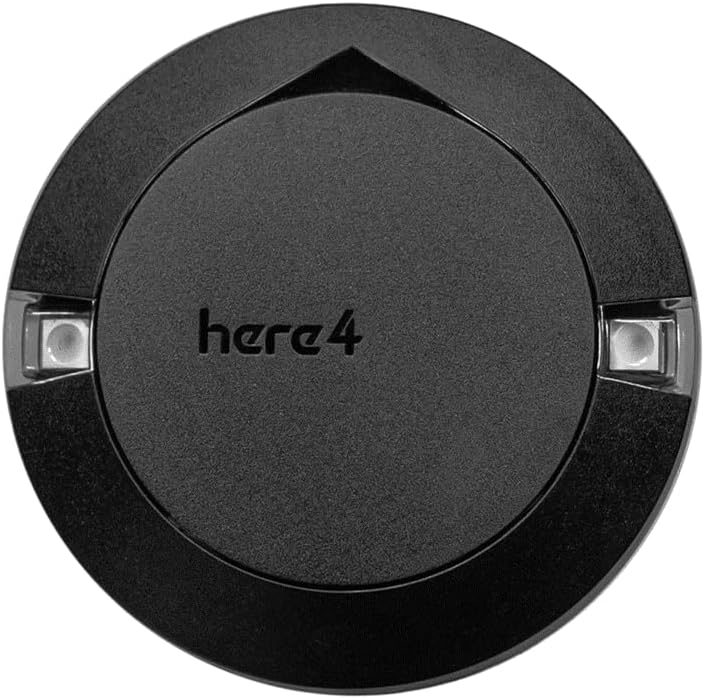
Figura 1: De dalt a baix view of the Here4 Multiband RTK GNSS module. This image displays the compact, circular design of the device, featuring a matte black finish with the product name "here4" subtly embossed on its surface. Two transparent sections on the sides reveal integrated LED indicators, suggesting status or operational feedback.

Figure 2: Feature highlights of the Here4 module. This diagram visually explains the core capabilities, including its high-precision positioning, powerful internal processing (STM32H7 chip), integrated flight control and navigation functions, and support for future expansion and customization via DroneCAN FD communication.
2. Configuració i instal·lació
Proper setup is crucial for optimal performance of the Here4 Multiband RTK GNSS module. Follow these general guidelines for installation and initial configuration.
2.1 Consideracions de muntatge
- Mount the Here4 module in a location with a clear, unobstructed view of the sky to ensure maximum satellite visibility.
- Avoid mounting near sources of electromagnetic interference (EMI), such as motors, ESCs, or high-current wires, as this can degrade GNSS performance.
- Ensure the module is securely fastened to prevent movement during operation, which could affect positioning accuracy.
- The module is designed for panel mounting. Utilize appropriate hardware to secure it firmly.
2.2 Connexió elèctrica
- Connect the Here4 module to your flight controller or host system using the provided CAN cable. The Here4 utilizes CAN FD for communication.
- Ensure correct polarity when connecting power. Refer to your flight controller's documentation for specific CAN port pinouts.
- The module integrates flight control and navigation functionalities, including 8 PWM or BDSHOT outputs, RCIN, Hotshoe, and camera trigger. Connect these as required by your specific application.
2.3 Configuració inicial
- After physical installation, connect your flight controller to a ground control station (GCS) software (e.g., Mission Planner, QGroundControl).
- Verify that the Here4 module is recognized by the flight controller and GCS.
- Configure GNSS settings within the GCS, including enabling RTK if a base station is used, and setting appropriate coordinate systems.
- Perform a compass calibration if the module's built-in compass is utilized.
3. Instruccions de funcionament
Operating the Here4 module involves monitoring its status and ensuring it acquires a reliable GNSS fix for accurate positioning.
3.1 Power On and Satellite Acquisition
- Once powered on, the Here4 module will begin searching for GNSS satellites.
- The built-in LEDs will indicate the module's status. Refer to the LED indicator section for specific patterns and their meanings.
- For a cold start, satellite acquisition may take up to 25 seconds. Aided start is 2 seconds, and hot start is 2 seconds.
3.2 RTK Fix and Accuracy
- For centimeter-level accuracy, an RTK (Real-Time Kinematic) fix is required. This involves receiving correction data from a base station.
- The module uses multi-frequency DGNSS signals and advanced algorithms to achieve a fast RTK fix, typically within 10 seconds.
- Monitor the RTK status in your GCS. A "RTK Fixed" status indicates the highest level of positioning accuracy.
3.3 Indicadors LED
The Here4 module features built-in LEDs that provide visual feedback on its operational status. Display modes can be customized via parameters or Lua Scripting.
- Verd sòlid: RTK Fixed.
- Verd intermitent: RTK Float.
- Blau sòlid: 3D GPS Fix.
- Blau intermitent: No GPS Fix / Searching for satellites.
- Vermell sòlid: Error or initialization issue.
4. Manteniment
The Here4 module is designed for durability, but proper maintenance can extend its lifespan and ensure consistent performance.
4.1 Neteja
- Gently wipe the exterior of the module with a soft, dry, lint-free cloth.
- No utilitzeu productes químics agressius, dissolvents ni netejadors abrasius, ja que poden danyar el casing o components interns.
- Ensure no dust or debris accumulates around the LED indicators or connection ports.
4.2 Emmagatzematge
- Quan no l'utilitzeu, guardeu el mòdul en un lloc fresc i sec, allunyat de la llum solar directa i de temperatures extremes.
- Protect the module from physical shock and vibration during storage and transport.
4.3 actualitzacions de microprogramari
- Periodically check the CubePilot official website or relevant community forums for firmware updates.
- Firmware updates can introduce new features, improve performance, or address known issues.
- Follow the manufacturer's instructions carefully when performing firmware updates to avoid damaging the device.
5. Solució De Problemes
This section provides solutions to common issues you might encounter with your Here4 Multiband RTK GNSS module.
5.1 No GNSS Fix / Long Acquisition Time
- Check Sky View: Assegureu-vos que el mòdul tingui una visió clara i sense obstacles view of the sky. Obstacles like buildings, trees, or dense foliage can block satellite signals.
- Interferència: Move the module away from potential sources of electromagnetic interference (e.g., motors, power lines, other electronic devices).
- Connexió: Verify that the CAN cable is securely connected to both the Here4 module and the flight controller/host system.
- Potència: Confirm the module is receiving adequate power.
5.2 Inaccurate Positioning / No RTK Fix
- Estació base RTK: Ensure your RTK base station is operational, correctly configured, and transmitting correction data.
- Correction Data Link: Verify the communication link between the base station and the Here4 module (via the flight controller) is stable.
- Col·locació de l'antena: Confirm the Here4 module's antenna is not obstructed or too close to metallic objects that could reflect signals.
- Firmware: Ensure both the Here4 module and your flight controller have the latest compatible firmware.
5.3 Module Not Detected by GCS
- CAN Bus Configuration: Check the CAN bus settings on your flight controller to ensure it's enabled and correctly configured for the Here4 module.
- Cablejat: Double-check all wiring connections, especially the CAN H and CAN L lines.
- Cicle d'alimentació: Try power cycling the entire system (flight controller and Here4 module).
6. Especificacions
Detailed technical specifications for the Here4 Multiband RTK GNSS module.
| Característica | Especificació |
|---|---|
| Mòdul GNSS | NEO-F9P |
| Processador | STM32H7 |
| Sensor IMU | ICM42688+RM3100 |
| Baròmetre | MS5611 |
| Protocol de comunicació | DroneCAN 8 Mbit/s |
| Tipus de receptor | Receptor GNSS d'alta precisió de doble banda |
| Sistemes GNSS | GPS, GLONASS, Galileo i BeiDou + SBAS i QZSS |
| Bandes de satèl·lit | B1I, B2a, E1B/C, E5a, L1C/A, L1OF, L5 |
| Màxim sistemes GNSS | 4 |
| Navigation update rate (RTK) | fins a 20 Hz |
| Precisió de posicionament | 0.01 m + 1 ppm CEP |
| Velocitat màxima | 500 m/s |
| Convergence time (RTK) | <10 seg |
| Adquisició | Arrancada en fred 25 s Arrancada assistida 2 s Arrancada en calent 2 s |
| Sensibilitat | Tracking & Navigation: -167 dBm Cold starts: -148 dBm Hot starts: -157 dBm Reacquisition: -160 dBm |
| Antena | Antena de doble banda |
| Protocols | NMEA, UBX binary, RTCM 3.3, SPARTN 2.0.1 |
| Anti-spoofing | Algoritmes avançats anti-spoofing |
| Pes de l'article | 7 unces |
| Dimensions del producte | 0.63 x 0.63 x 0.63 polzades |
| País d'origen | Taiwan |
| Tipus de muntatge | Suport al tauler |
| Tipus de visualització | LED |
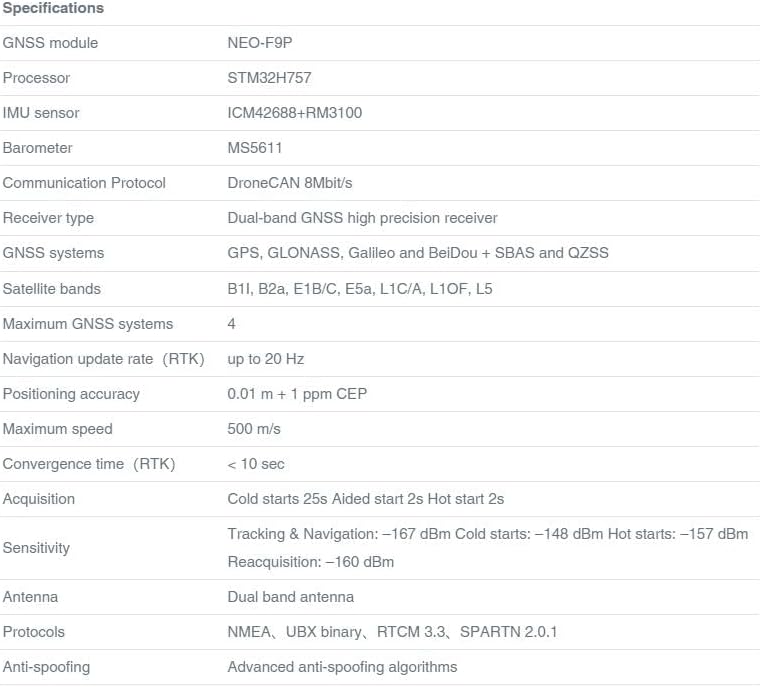
Figure 3: Visual representation of the Here4 module's specifications. This image presents a detailed table outlining various technical parameters such as GNSS module type, processor, IMU sensor, communication protocol, receiver type, supported GNSS systems, satellite bands, and performance metrics like positioning accuracy and convergence time.
7. Garantia i Suport
For warranty information and technical support, please refer to the official CubePilot weblloc web o contacteu directament amb el seu servei d'atenció al client.
- Fabricant: CubePilot
- Oficial Weblloc: www.cubepilot.org (Exampl'enllaç, l'enllaç real pot variar)
- Atenció al client: Consulteu l'oficial weblloc web per obtenir dades de contacte i recursos de suport.
Si us plau, conserveu el comprovant de compra per a qualsevol reclamació de garantia.


